You have no items in your shopping basket.
Trailblazers Worksheets
Nine A4 worksheets for select books within our Trailblazers series – and instructions on how to get the most out of them.
Get the worksheets
You can downloaded the worksheets by clicking on the images below – they are all downloadable pdf files.
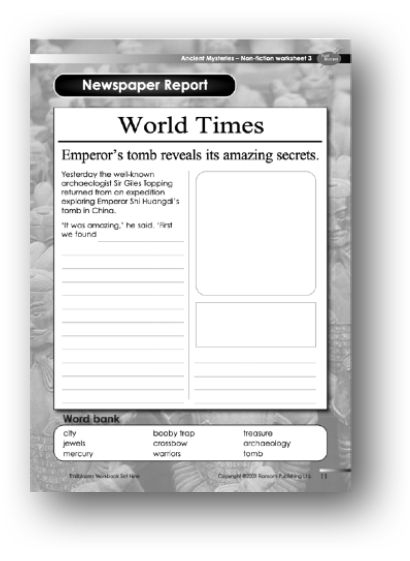
Ancient Mysteries
Level: Higher.
Task: To write a newspaper report.
Support: The worksheet has a partially completed newspaper report on an exploration of the tomb of Shi Huangdi. Students are required to complete it. There is also a word bank of useful words. First it might be helpful to review how to write a newspaper report, perhaps looking on the internet for newspaper reports of archaeological discoveries. Students may pick up on some of the ideas mentioned in the reading book text, particularly on pages 16 and 17, but they could also draw on other sections and could supplement these ideas with further information from the internet. This research could be used to extend the word bank on the worksheet. Students can then complete their report. Point out that, whatever happens, Sir Giles has to survive, given the way the report begins!
Great Disasters
Level: Lower.
Task: Cloze activities.
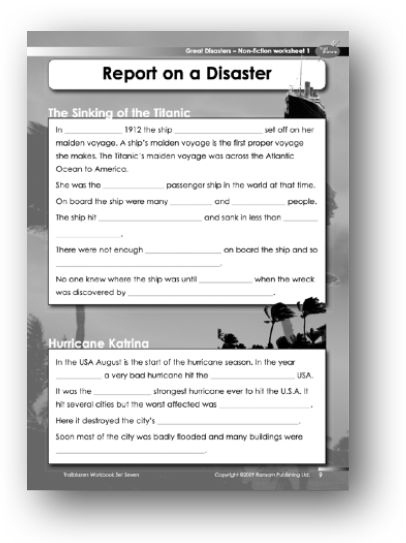
Support: The worksheet consists of two cloze activities giving details of the Titanic sinking and the disaster of Hurricane Katrina. Some additional information is included, but the most appropriate words for filling in the spaces can be found in the text of the reading book. Ensure that the students understand the significance of a ship’s maiden voyage. They should also appreciate that hurricanes are always given a name, by weathermen, when they are identified as such. Work through the texts orally before asking students to complete the worksheet.
Mummies
Level: Higher.
Task: Writing in a different format (newspaper report).
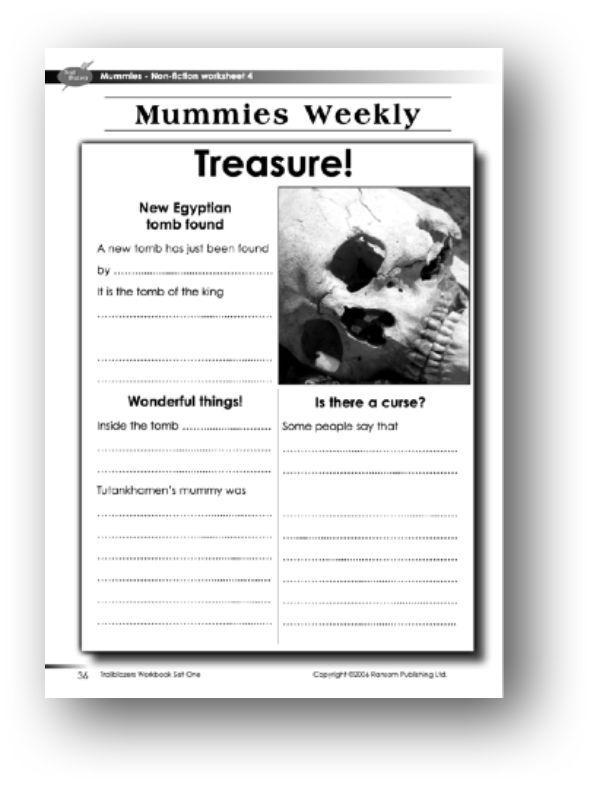
Support: Read Chapters 3, 4 and 5 of the non-fiction section of the book (‘How are mummies made?’, ‘Treasure’ and ‘The mummy’s curse’). Use the information in these chapters to compile a newspaper page. The sub-headings on the worksheet indicate the topics for each section, and a starter has been given. Pupils should be encouraged to finish off the sentence in each case, but should also try to add some further information appropriate to each section.
Plagues
Level: Lower.
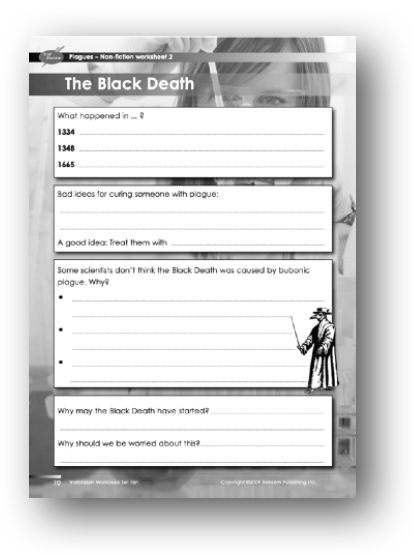
Support: Students are required i) to identify events that happened on three specific dates; ii) to discuss cures; iii) to write a short statement on alternative theories about what actually caused the plague; and iv) to write about why it started. The first two questions can be answered relatively easily by referring to pages 10 and 11 of the reading book. The third question, on alternative theories of the cause of the Black Death, is a more challenging activity. Work with the group to pick out key points from the reading book text on page 11. The key points are: the description of the disease does not match what we know about it now; in some places where the disease struck there were no rats; they think it was caused by a virus, not a bacteria. The final two questions on the worksheet refer to the climate change theory, which is mentioned on page 10 of the reading book.
Sharks
Level: Lower.
Task: To locate information from the text.
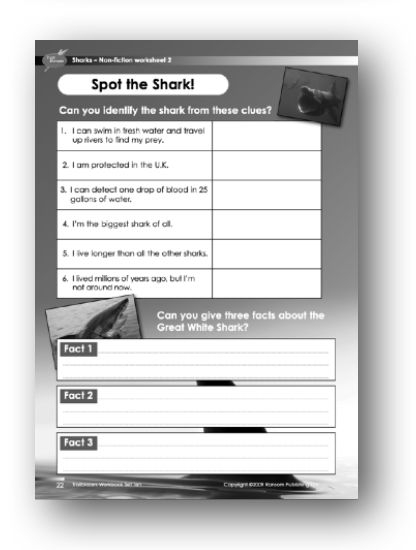
Support: The worksheet presents a table of facts about six different sharks. Students are required to identify the type of shark from the clue given and write the name of the shark in the second column. The correct answers are: 1. Bull Shark. 2. Basking Shark. 3. Great White Shark. 4. Whale Shark. 5. Spiny Dogfish. 6. Megalodon. Students are also asked to give three facts about the Great White Shark. If necessary, provide reading book page references for the students.
Spies
Level: Lower.
Task: To crack and to write coded messages.
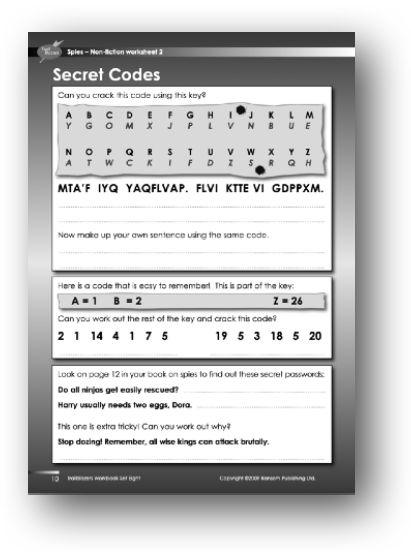
Support: The worksheet gives students a variety of codes to crack, and one message to encode. The codes are based on the text on page 12 of the ‘Spies’ reading book. The first code is a simple letter substitution code – locate the message letter on the second line, and replace it with the corresponding letter from the first line. The coded sentence reads: DON’T SAY ANYTHING. THIS ROOM IS BUGGED. The second code is a simple alpha-numeric code. Students should soon grasp the basis of this, and will be able to use it to write their own coded words and sentences. Writing out a column of letters with the appropriate numbers alongside will be helpful. The two words in code are: BANDAGE and SECRET. The code at the bottom of the worksheet uses the first letter of each word, as described at the bottom of page 12 of the ‘Spies’ reading book. The two secret passwords are: DANGER and HUNTED. The final sentence reads SDRAWKCAB – which is backwards – spelt backwards! Students might need a hint here.
UFOs
Level: Higher.
Task: Looking for evidence.
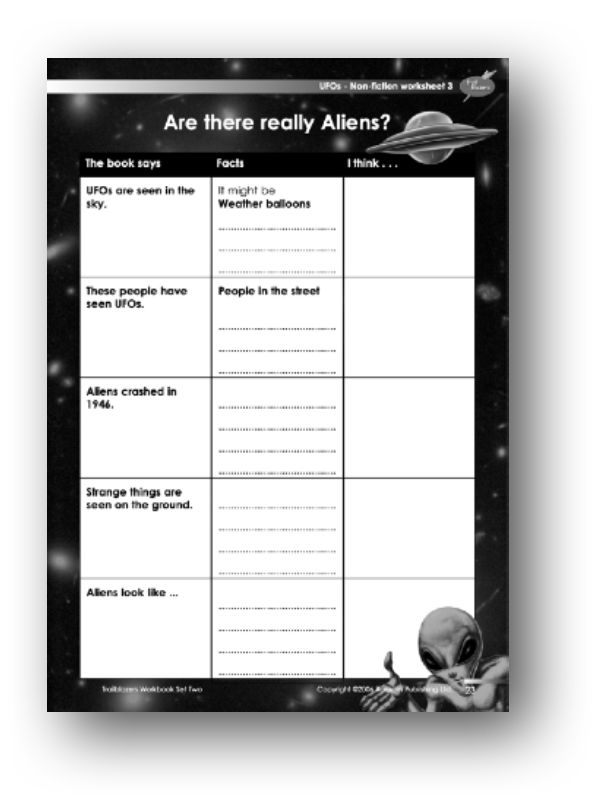
Support: Each row of the table on the worksheet relates to a different chapter in the non-fiction section of the book. Read the statement in the first box. Identify what the appropriate chapter says in support of the statement. List the evidence. Then in the final box write a personal opinion. This is a more challenging exercise and it might be more appropriate to complete it as a group task.
Vampires
Level: Lower.
Task: To design a travel brochure.
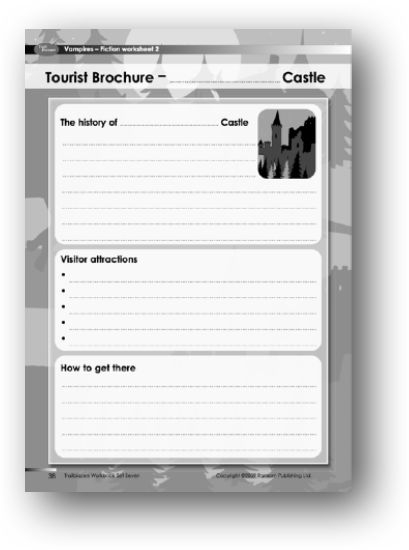
Support: Explain to students that the castle in the story ‘Blood In My Eyes’ has now become a tourist attraction, and that they are going to use the worksheet to design a travel brochure that will tempt people to go there. Discuss each section of the brochure, as outlined on the worksheet, and write notes on the board. Then ask the students to complete their own version of the brochure. Students should use their imagination to expand on the points given in the story. The first box should contain information on the castle’s history, including some of the events of the story. How can this be summed up in a paragraph? Students will also need to think of a name for the castle. The second box is for visitor attractions, e.g. refreshments, a museum, perhaps a gift shop. The final box shows practical information. How might visitors reach the castle from the local village? Might the castle provide a tourist bus service, for example?
Weird Creatures
Level: Lower.
Task: To design a poster for the sea-life centre.
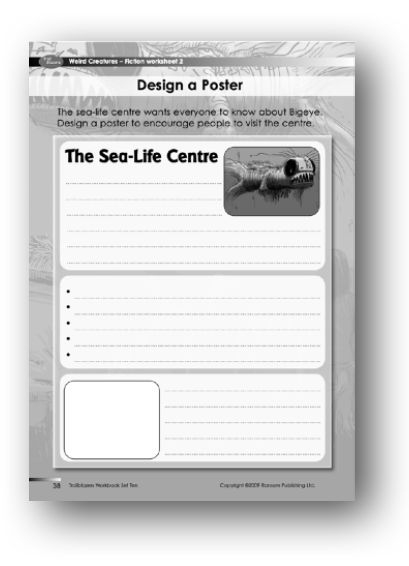
Support: The worksheet shows a blank poster for the sea-life centre featured in the story. Students are required to write and design the poster. First, discuss with the class the reasons why Bigeye would be of interest to the public. On the board, list useful words to help students write a brief description of Bigeye that would encourage people to visit the sea-life centre. Also discuss the sorts of words and phrases that are generally used to persuade people to visit attractions, and list these. Students can then design their posters. The poster could also be produced as an ICT activity.
Get the Trailblazers books
Our worksheets work best when students have access to our comic-style Trailblazers books.
Each of the titles gives readers the facts on a non-fiction ‘obsession’ topic, followed by a quick fiction story. They are dyslexia-friendly and specially written/designed to hook even the most reluctant readers.
To check out the series, head here.