

You have no items in your shopping basket.
Siti’s Sisters Worksheets
Eight A4 worksheets for select books within our Siti’s Sisters series – and instructions on how to get the most out of them.
Get the worksheets
You can downloaded the worksheets by clicking on the images below – they are all downloadable pdf files.
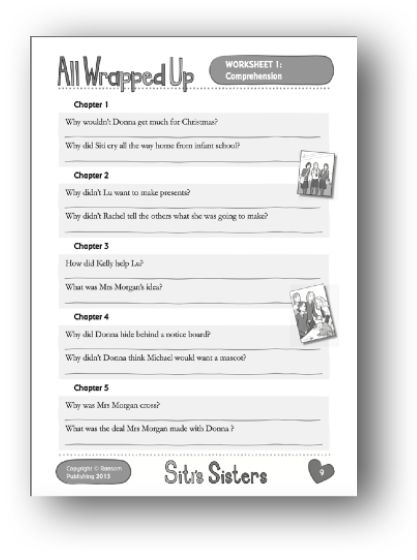
All Wrapped Up
Task: This is a straightforward comprehension activity.
Support: There are two questions for each chapter of the story. The questions appear in chapter order. Ask the students to re-read the chapter before answering the questions. If appropriate, discuss the questions with the students before asking them to provide a written answer. Note the implication in the story that Siti’s family do not celebrate Christmas.
Extension: Ask the students to devise a further question for each chapter.
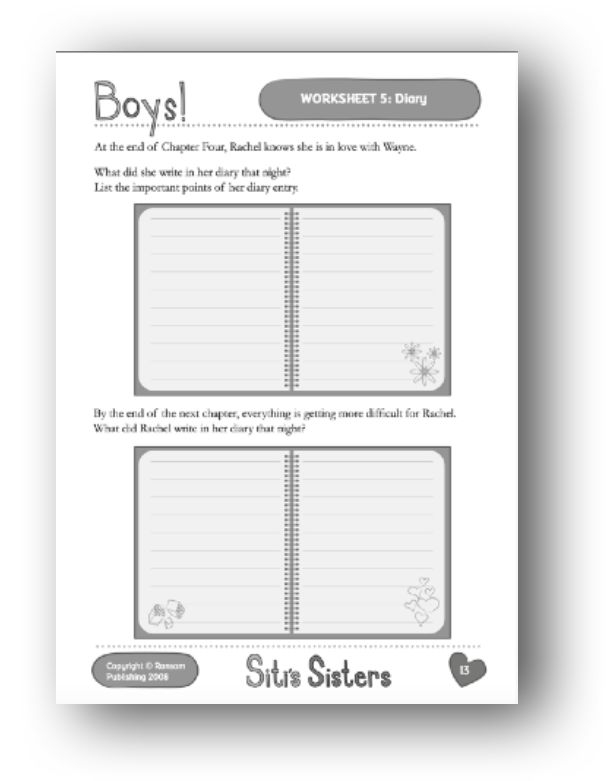
Boys!
Task: Writing in the first person and making notes for a diary entry.
Support: The first writing frame is for notes relating to Rachel’s feelings at the end of Chapter Four. The second frame is for the notes on Rachel’s feelings at the end of Chapter Five. Discuss the conventions of diary writing. Note that diary writing is in the first person and is informal. Note that diaries are intended to be secret, so the writing can be very honest. Then recap the events in Chapter Five. Discuss how Rachel is feeling at the end of that chapter. How does Rachel feel about Donna? Make notes, in the second frame, for a diary entry commenting on Donna and Wayne at this point in the story.
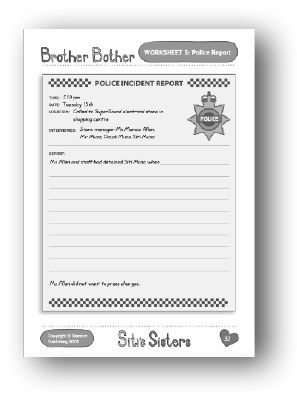
Brother Bother
Task: To write a formal report.
Support: Review the story from the start of Chapter Four. Discuss what each character might say to the policeman. Make notes for each person. Review these notes as part of a group activity. Decide what the policeman would see as the most important aspect of each person’s account. Decide whose views the policeman would be most likely to record first. Write these facts using a formal format. Discuss the sort of language a policeman might use in writing a formal report. List appropriate words and phrases on the board. What does it mean when the policeman writes ‘Ms Allen did not want to press charges’? Do you think this was the right way to deal with the situation?
Extension: Role-play. Imagine the policeman returning to the police station and recounting the scene to his colleagues. Tell the story you have written in the report in less formal language.
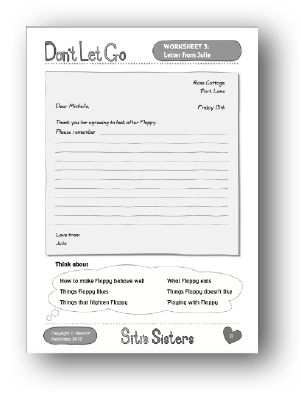
Don’t Let Go
Task: To write a letter.
Support: The students are required to write a letter from Julie (the owner of Floppy) to Kelly’s mum, explaining how to look after Floppy. Discuss the suggestions in the help box on the worksheet. Note the students’ responses. Some of the responses may be drawn from a reading of the story, but others will need to be suggestions from the students’ own experience. Ask the students to list their ideas in an appropriate order. Review the conventions of letter writing with the students. Note that this is an informal letter and therefore it would be appropriate to use lists, if required. The students can then write their letter.
Extension: Use the ideas from the letter to produce a help sheet for new dog owners. Alternatively, if the students have knowledge of caring for other animals, they could write about this animal instead. This could be an ICT opportunity.
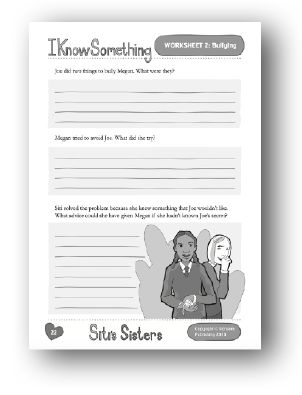
I Know Something
Task: To demonstrate understanding of the story; to extend the story.
Support: The first two questions on the worksheet are straightforward, and the answers can be found in the text. If appropriate, re-read the relevant sections with the students.
The final question is more open-ended. Discuss the problems with Joe that Megan experienced. Why did Siti take in the mouse? Ask the students if they think that this would solve the problem. Ask for suggestions from the students for ways of dealing with a bully. List these ideas on the worksheet.
Extension: Take one of the suggestions made by the students for dealing with Joe and use this to write an alternative ending to the story.
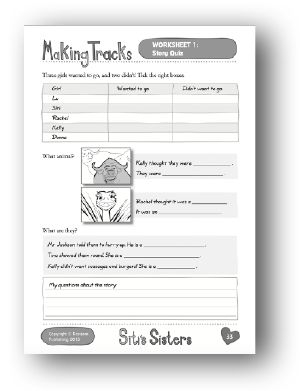
Making Tracks
Task: To write a review of the story.
Support: The questions on the worksheet review the story and should be attempted by the students without reference to the text. Read through the sheet with the students and, if appropriate, discuss their responses. Note that the answers to the ‘What are they?’ section on the worksheet are suggested by the information in the sentence about each person. Mr Jackson is a teacher, Tina is a warden and Kelly is a vegetarian. Finally the students are asked to pose some questions themselves. These could be straightforward questions or picture clues.
Extension: In the story the Sisters were visiting a local wetland centre. Identify a possible local venue for a school visit for the students. It may be a nature reserve, museum, historic site, technology centre or somewhere the students’ own school would visit. The students should then list reasons for and against visiting the venue.
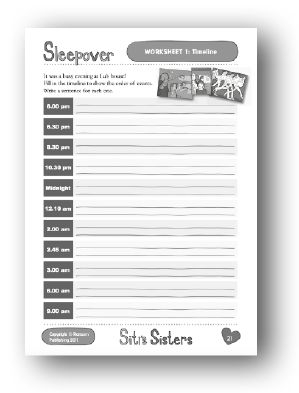
Sleepover
Task: To create a timeline for the story.
Support: Not every event in the story is given a specific time, though they can be worked out from the context. If necessary, read through the story and identify the points where a specific time is given e.g. at the start of the story, Lu asks her mum what time her friends may arrive. Fill these specific times in at the correct places on the worksheet. List the rest of the events of the story in order, then use clues from the story to fit in the events on the timeline into appropriate places. Ask the students for at least one complete sentence for each entry.
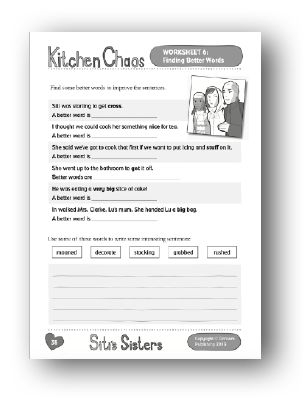
Kitchen Chaos
Task: To extend vocabulary.
Support: The sentences on the worksheet are all taken from the story. The students are asked to find an alternative to each word in bold. Before the students attempt the worksheet, read through the sentences and discuss possible options. Discuss the words in the boxes. Again, these words are taken from the story. Ask the students to select a few of these words and write a few sentences using them. The students should be encouraged to use these words in a different context.
Extension: Devise a quiz sheet based on the worksheet, where the students write simple sentences which could be improved with a better word choice. The students could then swap quiz sheets and attempt the task.
Get the Siti’s Sisters books
Our worksheets work best when students have access to our Siti’s Sisters books.
These perfectly-pitched stories follow a group of best friends as they tackle a range of real-life issues. The books are dyslexia-friendly and specially written/designed to hook even the most reluctant readers.
To check out the series, head here.