

You have no items in your shopping basket.
Goal! Worksheets
Five A4 worksheets for select books within our Goal! series – and instructions on how to get the most out of them.
Get the worksheets
You can downloaded the worksheets by clicking on the images below – they are all downloadable pdf files.
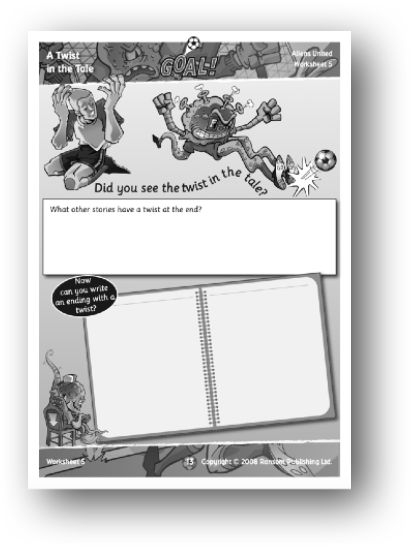
Aliens United
Task: To develop story reading and writing skills.
Activity: Discuss the storyline in the book and how there is a twist at the end. Ensure that the children understand the concept of a twist – something revealed at the end of the story that changes the story in a totally unexpected way. As the children were reading the story, how did they think that it would finish? What was the most likely ending? What was the ‘new’ piece of information that created the twist? Was it a successful twist? Did it surprise the children? Did it make the story better or more interesting? Ask the children to think of other stories they know that have a twist at the end. Then ask children to think of a new twist to the story Aliens United and to draw and write the text and pictures that would accompany the new end to the tale.
Extension: Discuss other types of story endings (e.g. a cliffhanger). Repeat the activity, but this time thinking of stories with cliffhanger endings. Then use the worksheet to create a cliffhanger ending for Aliens United.
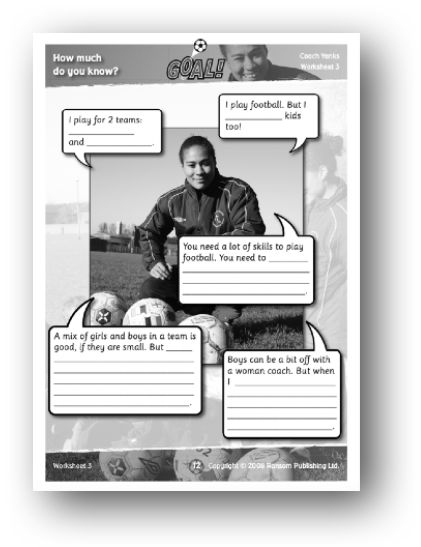
Coach Yanks
Task: Comprehension. Retrieving appropriate information from the text and completing simple sentences.
Activity: Re-read the book Coach Yanks. Then ask the children to look at the worksheet. Read each of Rachel’s speech bubbles one at a time, noting the blank spaces. Invite the children to discuss how the blanks could be filled in: what is Rachel saying in each one? Then ask the children to write their answers in the spaces provided, reminding them to use capital letters and full stops appropriately.
Extension: The children could create a similar worksheet of their own, based around their own favourite player. What kinds of things would their favourite player say about football, his team or his team-mates?
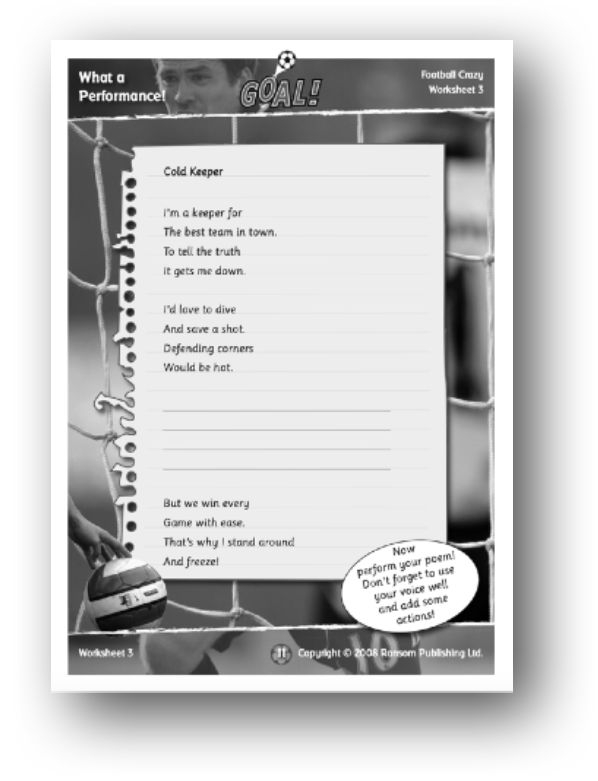
Football Crazy: Poems, Raps and Beats
Task: To develop poetic writing and performing skills.
Activity: Remind the children about the poem Cold Keeper from the book. Re-read the poem together, focusing on the rhythm. Ask the children to tell you about the rhythm and rhyme in this poem. Working together, discuss other situations that could be written about in relation to the poem, such as having to face a penalty or having to punch a cross away. Show the children the worksheet and explain that they need to add a new third verse to the poem. Ask the children to use the ideas they have discussed to write a new verse for the poem. Point out that at this point in the poem the keeper is still talking about all the things he or she would like to do: the ‘joke’ (the fact that the team is so good that they win every game with ease) isn’t really revealed until the final verse.
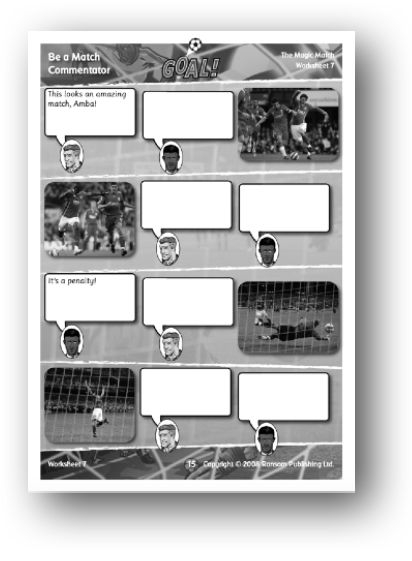
The Magic Match
Task: To develop speaking and listening skills and continue to practise simple sentence writing.
Activity: Remind the children about the context of The Magic Match. Discuss how football match commentators work for TV and radio broadcasters to describe the action on the pitch. Discuss how commentators often work. There is usually an ‘anchor man’ who provides most of the commentary, with a second commentator – often a football celebrity – who provides additional thoughts and comments. This person is often referred to as the ‘colour man’ because he makes the commentary more interesting (i.e. colourful). Talk about some of the clichés that commentators often use. Are there any examples in the book? Direct the children to look at the match photos on the worksheet and then discuss the incidents shown in each one. Ask the children to imagine they are the match commentator and to think of how they would describe the action. Now ask the children to write their match commentary and, when finished, to practise saying their commentary aloud. Again, remind the children about using the voice appropriately to build tension and grab the viewer’s/listener’s attention. Allow the children to perform their commentary to a group and, if possible, record it so that the children can listen to their voices.
The Mean Team
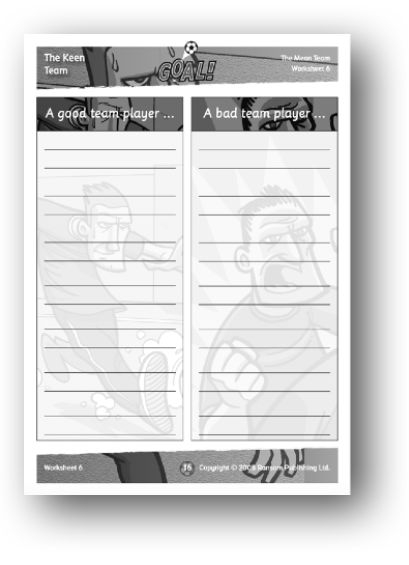
Task: To appreciate the ideals of teamwork and sportsmanship when playing sport, and being able to write these ideas in full sentences.
Activity: Ask the children to recount the story of The Mean Team. Ask them to reflect upon how Zak feels towards his team and his coaches in the book. Focus upon their lack of team work and how they play unfairly and argue all the time. Encourage the children to think about what makes a good team, and how teamwork and acting in a sporting way is more likely to achieve a positive result. Also discuss how teams that do not work together and play in an unfriendly manner often end up achieving nothing. Then give the children the worksheet and ask them to write their ideas on good and bad teamwork in the boxes provided. What kinds of behaviour make a good team? What are examples of bad team behaviour? When the children have completed the worksheet, ask them to share their ideas with the group.
Get the Goal! books
Our worksheets work best when students have access to our Goal! books.
These 48 fiction and non-fiction titles are based around Letters and Sounds (Phases 1 to 5) and are ideal for engaging football-mad reluctant readers.
To check out the series, head here.